1.3 — Egyptian Art and Architecture
The art and architecture of ancient Egypt represent one of the most enduring and instantly recognizable artistic traditions in world history. For over 3,000 years, Egyptian artists and architects created works of remarkable consistency and power, designed to last for eternity and guided by rigid conventions that remained largely unchanged for millennia. This chapter explores the distinctive characteristics of Egyptian art and how they reflected the culture's profound beliefs about life, death, and immortality.
Introduction to Ancient Egyptian Civilization
Ancient Egyptian civilization developed along the Nile River valley beginning around 3100 BCE, when Upper and Lower Egypt were unified under a single ruler. The regularity of the Nile's annual flooding created agricultural abundance that supported a complex society with specialized labor, including dedicated artists and craftspeople.
Historical Periods
Egyptologists divide ancient Egyptian history into several major periods:
- Predynastic Period (c. 5500-3100 BCE): Formation of distinct Egyptian culture
- Early Dynastic Period (c. 3100-2686 BCE): Dynasties 1-2, establishment of unified kingdom
- Old Kingdom (c. 2686-2181 BCE): Dynasties 3-6, age of pyramid building
- First Intermediate Period (c. 2181-2055 BCE): Political fragmentation
- Middle Kingdom (c. 2055-1650 BCE): Dynasties 11-13, cultural renaissance
- Second Intermediate Period (c. 1650-1550 BCE): Hyksos rule in northern Egypt
- New Kingdom (c. 1550-1069 BCE): Dynasties 18-20, imperial age and peak of power
- Third Intermediate Period (c. 1069-664 BCE): Political division
- Late Period (664-332 BCE): Final native dynasties and Persian rule
- Ptolemaic Period (332-30 BCE): Greek rule following Alexander's conquest
- Roman Period (30 BCE-395 CE): Egypt as a Roman province
Key Concepts in Egyptian Art
To understand Egyptian art, we must first recognize several fundamental concepts that guided its creation:
Funerary Function
Much of surviving Egyptian art was created for tombs and mortuary temples, designed to assist the deceased in the afterlife. Art was functional rather than purely decorative, serving specific religious and magical purposes.
Eternal Perspective
Egyptian artists depicted subjects from their most characteristic and complete angle, creating a conceptual rather than perceptual representation. This approach aimed to represent the eternal essence of a subject rather than a momentary appearance.
Hierarchical Scale
The size of figures in Egyptian art reflected their importance. Pharaohs and gods were shown larger than ordinary people, and masters larger than servants, creating a visual hierarchy that reflected social and divine order.
Canonization and Consistency
Egyptian art followed strict canonical rules and proportions, ensuring consistency across time and geographic regions. These conventions changed remarkably little over three millennia, creating a distinctive and instantly recognizable style.
Definition: Canon of Proportions
The Egyptian canon of proportions was a grid system used to establish standard measurements for depicting the human figure. A standing figure typically measured 18 squares from the soles of the feet to the hairline, ensuring consistency across different works and artists.
Architecture: Building for Eternity
Egyptian architecture is characterized by massive scale, geometric simplicity, and exceptional durability, designed to last for eternity.
Pyramids: Tombs for the Divine Kings
The most iconic Egyptian structures are the pyramids, enormous royal tombs built primarily during the Old Kingdom period:
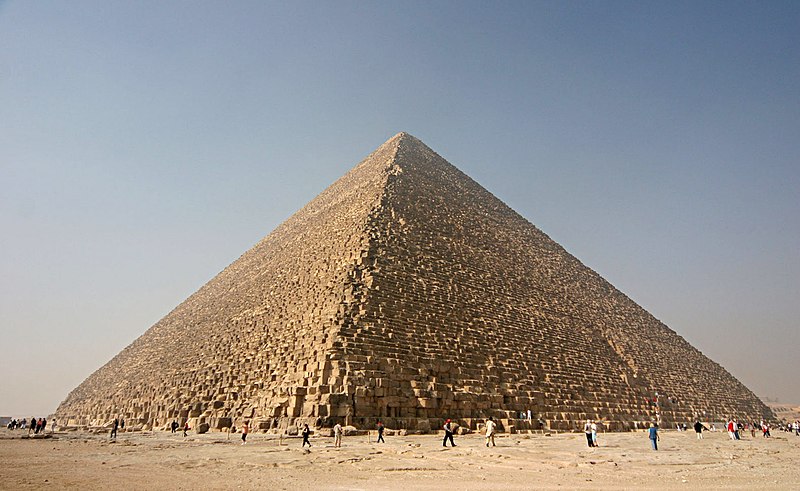
Key aspects of pyramid construction included:
- Evolution from earlier mastaba tombs through step pyramids to true pyramids
- Precise cardinal orientation and sophisticated engineering
- Complex internal chambers and passages
- Part of larger mortuary complexes including temples and boat pits
- Symbolic connection to the sun god and creation myths
Temples: Houses of the Gods
Egyptian temples were designed as residences for gods, with increasingly sacred spaces as one moved inward:

Typical temple features included:
- Massive pylon gateways marking the entrance
- Open courtyards transitioning to covered hypostyle halls
- Progressively smaller and darker chambers
- The sanctuary housing the cult statue at the rear
- Relief carvings and paintings covering all surfaces
- Alignment with astronomical events
Rock-Cut Architecture: The Temples of Abu Simbel
Some of the most impressive Egyptian monuments were carved directly into living rock, such as the temples at Abu Simbel:

These massive structures demonstrated both technical virtuosity and imperial ambition, often serving both religious and political purposes by impressing Egypt's power upon neighboring territories.
Sculpture: Immortalizing the Human Form
Egyptian sculpture was designed to preserve the likeness and identity of individuals for eternity, particularly in tomb contexts.
Royal Sculpture: The Face of Authority
Statues of pharaohs combined idealized features with individual characteristics:

Royal statues featured:
- Frontal, symmetrical poses with left foot forward (for male figures)
- Idealized, muscular bodies representing eternal youth and power
- Royal regalia including crowns, false beards, and scepters
- Serene, timeless expressions
- Polished, durable materials like granite and diorite
Non-Royal Sculpture: Servants for the Afterlife
Tomb owners commissioned statues of themselves, family members, and servants to populate their eternal dwelling:

Non-royal sculpture often displayed:
- Greater naturalism and individualism than royal works
- Figures shown engaged in their earthly occupations
- Hierarchical scaling based on social importance
- Painted surfaces to enhance lifelike appearance
Note: Ka Statues
Many tomb sculptures served as a home for the ka, an aspect of the soul that required sustenance in the afterlife. If the mummified body was damaged, the ka could inhabit these statues, ensuring the deceased's eternal survival.