1.2 — Mesopotamian Art
Mesopotamia, often called the "cradle of civilization," witnessed the rise of the world's first urban societies and the development of complex artistic traditions that would influence art throughout the ancient Near East and beyond. The artistic achievements of the Sumerians, Akkadians, Babylonians, and Assyrians provide crucial insights into the development of early civilizations.
Introduction to Mesopotamian Civilization
Mesopotamia (from the Greek meaning "between rivers") refers to the land between the Tigris and Euphrates rivers in modern-day Iraq, Kuwait, and parts of Syria, Turkey, and Iran. This region saw the emergence of the world's first cities, the invention of writing, and the development of complex political and religious systems beginning around 4000 BCE.
Historical Context
The history of Mesopotamia spans several major civilizations and periods:
- Sumerian Period (c. 4500-2334 BCE): Establishment of city-states
- Akkadian Empire (c. 2334-2154 BCE): First multi-ethnic empire
- Neo-Sumerian Period (c. 2112-2004 BCE): Revival of Sumerian culture
- Babylonian Period (c. 1900-539 BCE): Including the height of power under Hammurabi
- Assyrian Period (c. 911-609 BCE): Military empire known for monumental art
- Neo-Babylonian Period (c. 626-539 BCE): Final flowering before Persian conquest
Definition: Ziggurat
A ziggurat is a massive stepped temple tower, built by the ancient Sumerians, Babylonians, and Assyrians. These mud-brick structures elevated temples above the surrounding landscape and symbolized the connection between heaven and earth.
Sumerian Art
The Sumerians created the first major artistic tradition in Mesopotamia, establishing conventions that would influence subsequent cultures in the region.
Architecture: The Birth of Monumental Building
Sumerian cities were dominated by massive temple complexes centered around ziggurats, the most famous being the Great Ziggurat of Ur:

Architectural characteristics included:
- Mud brick as the primary building material (stone was scarce in Mesopotamia)
- Stepped platforms raising temples above the flat landscape
- Buttressed façades with recessed niches for visual interest
- Enclosed temple precincts accessible only to priests and rulers
Sculpture: Votive Figures
Among the most distinctive Sumerian artworks are votive statues placed in temples to pray perpetually on behalf of their donors:

Characteristics of Sumerian sculpture include:
- Stylized forms with simplified features
- Frontal presentation with symmetrical compositions
- Enlarged eyes symbolizing attentiveness to the divine
- Hands clasped in prayer postures
- Inscriptions identifying the donor and their wishes
Relief Sculpture and The Standard of Ur
The Standard of Ur (c. 2600-2400 BCE) exemplifies the Sumerian narrative relief technique:

This wooden box decorated with inlaid shell, red limestone, and lapis lazuli depicts scenes of war and peace in horizontal registers (narrative bands). The artist used hierarchical scale (important figures shown larger) and combined multiple perspectives to tell complex stories.
Akkadian Art: The Rise of Royal Imagery
Under Sargon of Akkad and his successors (c. 2334-2154 BCE), Mesopotamian art increasingly focused on glorifying rulers and military conquests.
The Victory Stele of Naram-Sin
This iconic monument celebrates King Naram-Sin's victory over the Lullubi mountain people:

This stele introduces several innovations in Mesopotamian art:
- A diagonal composition suggesting movement up a mountain
- The king depicted wearing a horned helmet (previously reserved for gods)
- Naturalistic rendering of the human body in profile
- Cosmic elements (sun rays above) connecting the king's victory to divine favor
Neo-Sumerian and Babylonian Art
The period following Akkadian rule saw both a revival of Sumerian artistic traditions and the emergence of new Babylonian styles, particularly under Hammurabi (r. 1792-1750 BCE).
The Code of Hammurabi
Perhaps the most famous artwork from this period is the stele containing Hammurabi's legal code:

The upper register shows Hammurabi receiving the laws from the seated sun god Shamash. This scene combines religious authority with royal power, legitimizing the king's role as lawgiver. Below this image, detailed legal texts were carved in cuneiform script.
Assyrian Art: Imperial Propaganda
The Assyrian Empire (911-609 BCE) used art as an instrument of imperial propaganda, developing a distinctive style focused on military might and royal authority.
Palace Reliefs
The most spectacular Assyrian artworks are the massive stone relief panels that lined the walls of royal palaces:

Characteristics of Assyrian relief sculpture include:
- Detailed, naturalistic depictions of animals, especially in hunting scenes
- Precise renderings of military campaigns and battle scenes
- Clear narrative sequences reading from left to right
- Combination of profile and frontal views to maximize clarity
- Consistent size and proportion to maintain visual coherence across large palace walls
Note: The Assyrian Royal Lion Hunt
The lion hunt was both a royal sport and a symbolic ritual in Assyria. By killing lions (symbols of chaos), the king demonstrated his ability to protect the ordered civilization from external threats. These hunts took place in controlled arenas, and the detailed reliefs celebrating them served as powerful propaganda for the king's strength and courage.
Monumental Gateway Sculptures
Massive human-headed winged bulls and lions (called lamassu) guarded the entrances to Assyrian palaces:

These hybrid creatures combined the strength of a bull or lion, the wings of an eagle, and the intelligence of a human. They were designed to be seen both from the front and in profile (with five legs). The lamassu served both as supernatural guardians and as impressive symbols of royal power.
Neo-Babylonian Art: The Final Flowering
Under Nebuchadnezzar II (r. 605-562 BCE), Babylon experienced a renaissance, with ambitious building projects and artistic achievements.
The Ishtar Gate
The most spectacular surviving example of Neo-Babylonian art is the Ishtar Gate and Processional Way:
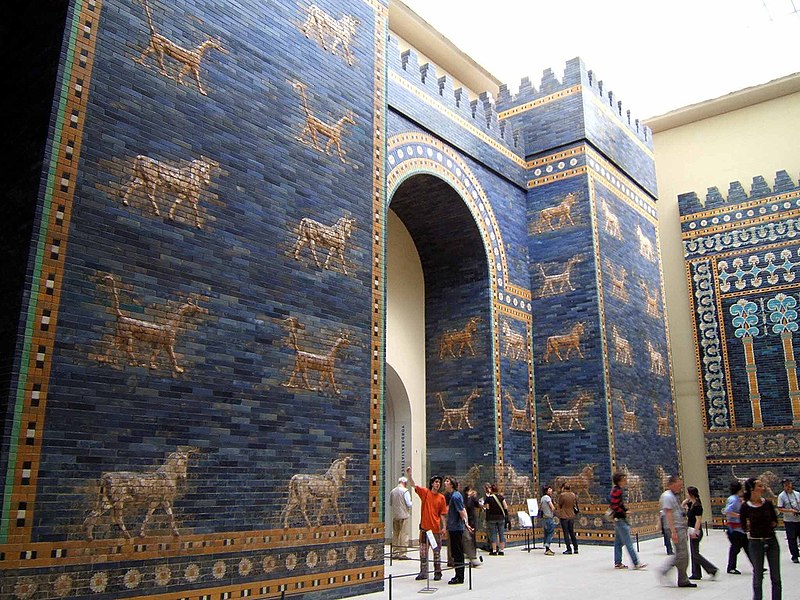
This massive gate, dedicated to the goddess Ishtar, featured:
- Vibrant blue glazed bricks as the background
- Rows of bas-relief animals representing deities (lions for Ishtar, bulls for Adad, dragons for Marduk)
- Alternating rows creating a rhythmic pattern along the processional way
- Technical mastery of glazed brick technology
Legacy and Influence of Mesopotamian Art
The artistic innovations of Mesopotamia had far-reaching impacts:
- Development of monumental architecture and urban planning
- Creation of visual narratives to communicate political and religious messages
- Establishment of royal iconography that influenced later empires
- Technical achievements in materials and methods
- Integration of text and image (as seen in stelae and kudurru boundary stones)
From these foundations, the artistic traditions of the ancient Near East would continue to evolve, influencing neighboring cultures and establishing patterns that would resonate throughout the history of Western and Middle Eastern art.